
Automotive Sensor Seals Manufacturer
Reliable Vehicle Protection with Custom Silicone Sensor Seals
LSRParts manufactures custom automotive sensor seals for OEMs, Tier suppliers and engineering teams that require consistent sealing performance, dimensional control and reliable production at scale. Using liquid silicone rubber molding, compression molding, overmolding and precision tooling, we produce silicone components designed around your sensor housing, connector, operating environment and assembly requirements.
Our engineering support covers the complete development path from DFM review and material selection to mold design, sampling, validation, mass production, inspection and packaging.
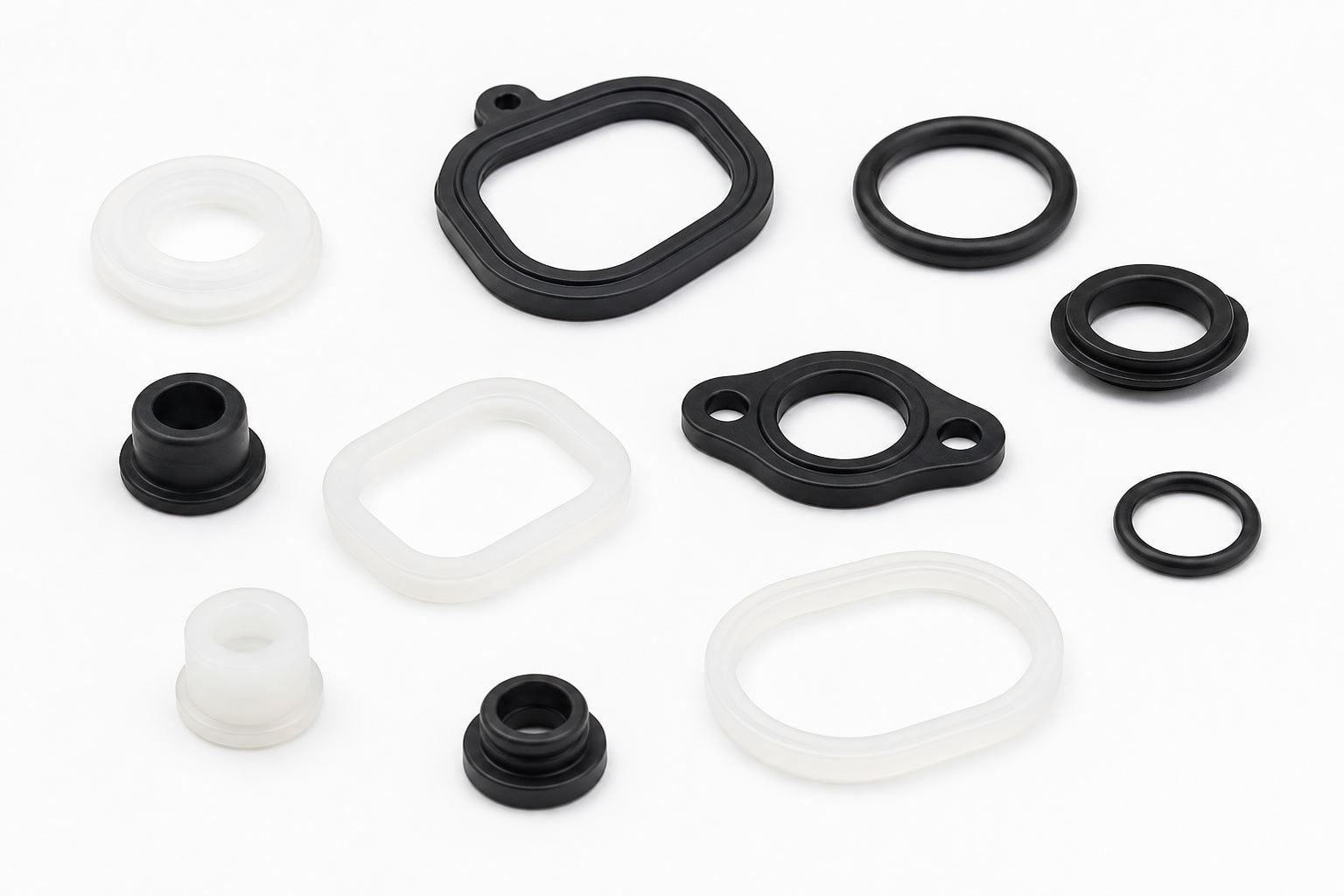
Custom Silicone Seals for Automotive Sensors
Automotive sensors operate in environments exposed to vibration, temperature changes, moisture, oils, fuels, cleaning chemicals and pressure fluctuations. A sensor seal must maintain its sealing function without interfering with electrical connections, installation or long-term service performance.
Depending on the design, the seal may be molded as a separate gasket, integrated into a housing, or overmolded onto a plastic or metal substrate.
Engine and powertrain sensors
Temperature and pressure sensors
Speed and position sensors
Oxygen and exhaust sensors
Battery and thermal management sensors
Transmission sensors
Fuel system sensors
Brake and chassis sensors
ADAS and vehicle body sensors
EV charging and high-voltage systems
Connector and wire-entry sealing systems
Automotive Sensor Seal Manufacturing Capabilities
LSR Injection Molding
Liquid silicone rubber injection molding is suitable for precision automotive sensor seals with repeatable geometry, thin sealing lips, controlled compression features and multi-cavity production tooling.
LSR injection molding can support consistent part-to-part performance for programs with annual demand above 100,000 pieces and repeat-production requirements.
Key Advantage: Precision thin-wall geometries with multi-cavity tooling for high-volume production consistency.
| Parameter | LSRParts Capability |
|---|---|
| Process | Liquid silicone rubber injection molding |
| Maximum part envelope | 300 × 200 × 100 mm |
| Silicone hardness | 10–80 Shore A |
| Typical part tolerance | ±0.05 mm |
| Critical tolerance | Down to ±0.02 mm, application dependent |
| Mold manufacturing tolerance | ±0.01 mm |
| Mold cavities | Single-cavity or multi-cavity |
| Production mold life | 3–5 million shots, tooling and application dependent |
| Mold materials | P20, H13, 420 stainless steel |
| Production scale | Prototype to high-volume production |
| Color | Custom color and Pantone matching |
| Surface | Custom texture, matte or polished |
| Secondary operations | Post-curing, trimming, marking, bonding, assembly and inspection |
LSR Overmolding
LSR overmolding integrates silicone sealing or protection directly onto a plastic or metal component. This process can reduce the number of assembly steps and help maintain seal alignment during installation.
LSRParts works with the customer to evaluate chemical bonding, mechanical retention, insert geometry, substrate preparation and mold design.
Common substrates include:
| Parameter | Capability |
|---|---|
| Maximum part envelope | 300 × 200 × 100 mm |
| LSR hardness | 10–80 Shore A |
| Mold tolerance | ±0.01 mm |
| Typical part tolerance | ±0.05 mm |
| Mold cavities | Single-cavity or multi-cavity |
| Mold life | 3–5 million shots, tooling dependent |
| Bonding strategy | Chemical and/or mechanical |
| Insert molding | Supported |
| Typical applications | Sensor seals, connector seals, housings and wire-entry protection |
| Post-processing | Post-cure, trimming, marking, assembly and inspection |
Silicone Compression Molding
Compression molding is available for silicone sensor gaskets and larger or less complex sealing components. It can also be considered for selected development programs, lower-volume production requirements or designs that are not suited to LSR injection molding.
The appropriate molding process depends on seal geometry, tolerance requirements, material specification, production volume, tooling investment and assembly method.
| Parameter | Capability |
|---|---|
| Maximum size | 2500 × 2000 × 1000 mm |
| Typical part tolerance | ±0.2 mm |
| Small-part mold cavity tolerance | ±0.1–0.2 mm |
| Complex-part mold cavity tolerance | ±0.3–0.5 mm |
| Cavities | Single-cavity or multi-cavity |
| Mold materials | P20, H13, 420 stainless steel |
| Secondary operations | Post-cure, trimming, punching, drilling, bonding, assembly and inspection |
Silicone Materials for Automotive Sensor Seals
Material selection is based on the sensor's operating temperature, chemical exposure, compression requirements, electrical environment and service life expectations.
Silicone hardness is available from approximately 10 to 80 Shore A, depending on the selected material and design. For automotive sensor seals, hardness should be evaluated together with groove dimensions, compression ratio, sealing force, installation method and environmental conditions.
Where required, LSRParts can support custom colors, surface finishes and material selection for specific application conditions. Customers should provide the expected temperature range, fluid exposure, pressure, sealing interface, regulatory requirements and validation standards when requesting a material recommendation.
| Material | Typical Considerations |
|---|---|
| General-purpose LSR | Industrial and electronics applications |
| Fluorosilicone | Fuel, oil and chemical exposure |
| High-temperature silicone | Automotive and high-temperature industrial environments |
| Low-temperature silicone | Outdoor and low-temperature applications |
| Flame-retardant silicone | Electrical and automotive systems |
| Electrically conductive silicone | Electrical contact and EMI-related requirements |
| Custom silicone compounds | Application-specific performance requirements |
Design Factors for Automotive Sensor Seals
A reliable sensor seal begins with the interface design. During DFM review, LSRParts evaluates the following factors:
Groove and Compression Design
The seal cross-section, groove depth and compression ratio must work together to achieve the required sealing force without excessive installation stress or permanent deformation.
Flash and Parting Line Control
Sealing lips and functional surfaces should be positioned with consideration for mold parting lines, flash control and trimming access. Critical sealing areas may require specific tooling strategies and inspection controls.
Tolerances and Shrinkage
Silicone parts are affected by material shrinkage, geometry, mold temperature and process conditions. LSRParts reviews critical dimensions and establishes practical tolerance requirements before production tooling begins.
Draft, Undercuts and Demolding
The design of undercuts, retaining features and demolding angles affects tool complexity, cycle time and part consistency. Where appropriate, mechanical retention can be combined with chemical bonding in an overmolded design.
Substrate Compatibility
For overmolded sensor assemblies, the plastic or metal substrate must be evaluated for dimensional stability, surface condition, thermal behavior and compatibility with the selected bonding system.
Venting and Air Traps
Proper venting is important for avoiding trapped air, incomplete filling and cosmetic or functional defects, especially around thin sealing lips and enclosed insert features.
Assembly and Handling
The seal should be designed for repeatable installation. LSRParts can review insertion direction, retention features, lubrication requirements, automated assembly considerations and packaging protection.
Automotive Sensor Seal Applications
Connector and Wire-Entry Seals
Silicone seals can protect electrical interfaces from water, dust, vibration and environmental contamination. Applications may include wire seals, connector perimeter gaskets and cable-entry seals.
Sensor Housing Gaskets
Custom gaskets can seal the joint between a sensor cover, housing and mounting interface. The design may include locating features, compression stops or integrated retention elements.
EV Battery and Thermal Management Sensors
Electric vehicles use sensors throughout battery packs, cooling circuits and thermal management systems. Silicone seals may be designed for coolant exposure, temperature cycling, electrical insulation and constrained assembly spaces.
Engine and Exhaust Sensor Seals
Powertrain and exhaust environments may require materials with improved resistance to elevated temperatures, oils, fuels and chemical exposure. High-temperature silicone and fluorosilicone compounds may be considered based on the application.
Pressure and Fluid Control Sensors
Sensors used in fluid systems may require a diaphragm, gasket or sealing membrane that maintains flexibility and dimensional stability during pressure changes and repeated cycling.
From DFM Review to Mass Production
LSRParts supports automotive sensor seal projects through a defined development workflow:
Drawing and specification review
We review 2D drawings, 3D CAD files, material requirements, critical dimensions and performance expectations.
DFM and sealing-interface analysis
The team evaluates wall thickness, sealing lips, grooves, draft, undercuts, flash requirements, shrinkage, tolerances and demolding.
Material selection
Silicone hardness, cure system, temperature resistance, chemical compatibility, color and regulatory requirements are considered.
Mold design
We develop prototype or production tooling using the selected cavity arrangement, mold steel, venting strategy and parting-line layout.
Tool manufacturing
Tooling may use CNC machining, sinker EDM, wire EDM and precision finishing.
T0/T1 sampling
Initial samples are produced for dimensional review, assembly checks and design validation.
Validation and production approval
Samples and inspection data support customer testing and approval before volume production.
Mass production and inspection
Approved parts are manufactured using controlled molding, secondary operations and final inspection procedures.
Assembly and packaging
Where required, LSRParts provides bonding, marking, assembly, functional testing and custom packaging.
Precision Tooling for Sensor Seal Production
LSRParts provides prototype and production tooling for custom automotive silicone components.
Prototype tool lead time: Benchmark approximately 10–12 days
Production tool lead time: Benchmark approximately 3–6 weeks
Actual lead time depends on part complexity, mold structure, cavity count, material requirements, insert design and customer approval timing.
| Tooling Capability | Specification |
|---|---|
| DFM | Supported |
| CAD | SolidWorks and CAD |
| Mold flow review | Supported |
| CNC machining | 3-axis and 5-axis |
| EDM | Sinker EDM and wire EDM |
| Rapid tooling | Aluminum tooling |
| Rapid tool life | Approximately 100–10,000 cycles |
| Production tooling | Hardened steel tooling |
| Common mold steels | P20, NAK80, H13, S136 and 420 |
| Stainless tooling | 316 and 420 where applicable |
| Aluminum tooling | 6061 and 7075 |
| Tool surface finish | Ra 0.8 μm or better where required |
| Prototype tool lead time | Benchmark approximately 10–12 days |
| Production tool lead time | Benchmark approximately 3–6 weeks |
| Sampling | T0, T1 and validation |
| Multi-cavity tooling | Available |
| High-volume tooling | Available |
Secondary Operations and Inspection
Automotive sensor seals may require additional operations after molding. Available services include:
Inspection Planning
Inspection planning can be based on customer drawings, critical-to-function dimensions, sealing surfaces, appearance criteria and assembly requirements.
For overmolded components, inspection may include substrate position, bond coverage, retention features and interface dimensions.
Information to Provide for a Sensor Seal Quote
To evaluate a custom automotive sensor seal project, provide as much of the following information as available:
- 2D drawing and 3D CAD file
- Sensor housing or mating-part details
- Seal material and hardness requirements
- Operating temperature range
- Exposure to oil, fuel, coolant, water or cleaning chemicals
- Pressure and vacuum conditions
- Required sealing standard or validation method
- Critical dimensions and tolerances
- Annual production volume
- Prototype quantity
- Target production timing
- Color, marking and packaging requirements
- Overmolding substrate information, if applicable
LSRParts can then review the design, identify tooling and manufacturing considerations, and recommend a suitable production route.
Request a Custom Automotive Sensor Seal Review
LSRParts supplies custom automotive sensor seals for OEM and Tier supplier programs requiring engineering support, precision tooling and repeatable production. Send your drawing, application requirements and estimated annual volume for a DFM and manufacturing assessment.