
Custom Silicone Manufacturing
Multi-Component Molding for Custom Silicone Parts
LSRParts provides custom multi-component molding for OEMs and engineering teams that need silicone parts combined with plastic or metal substrates in a repeatable production process. Our capabilities include LSR overmolding, insert molding, precision mold making, material selection, sampling, validation, mass production and secondary operations.
Send us your drawing, 3D model or application requirements for an RFQ. We can review the design, recommend a suitable bonding strategy and define a practical path from prototype tooling to stable production.
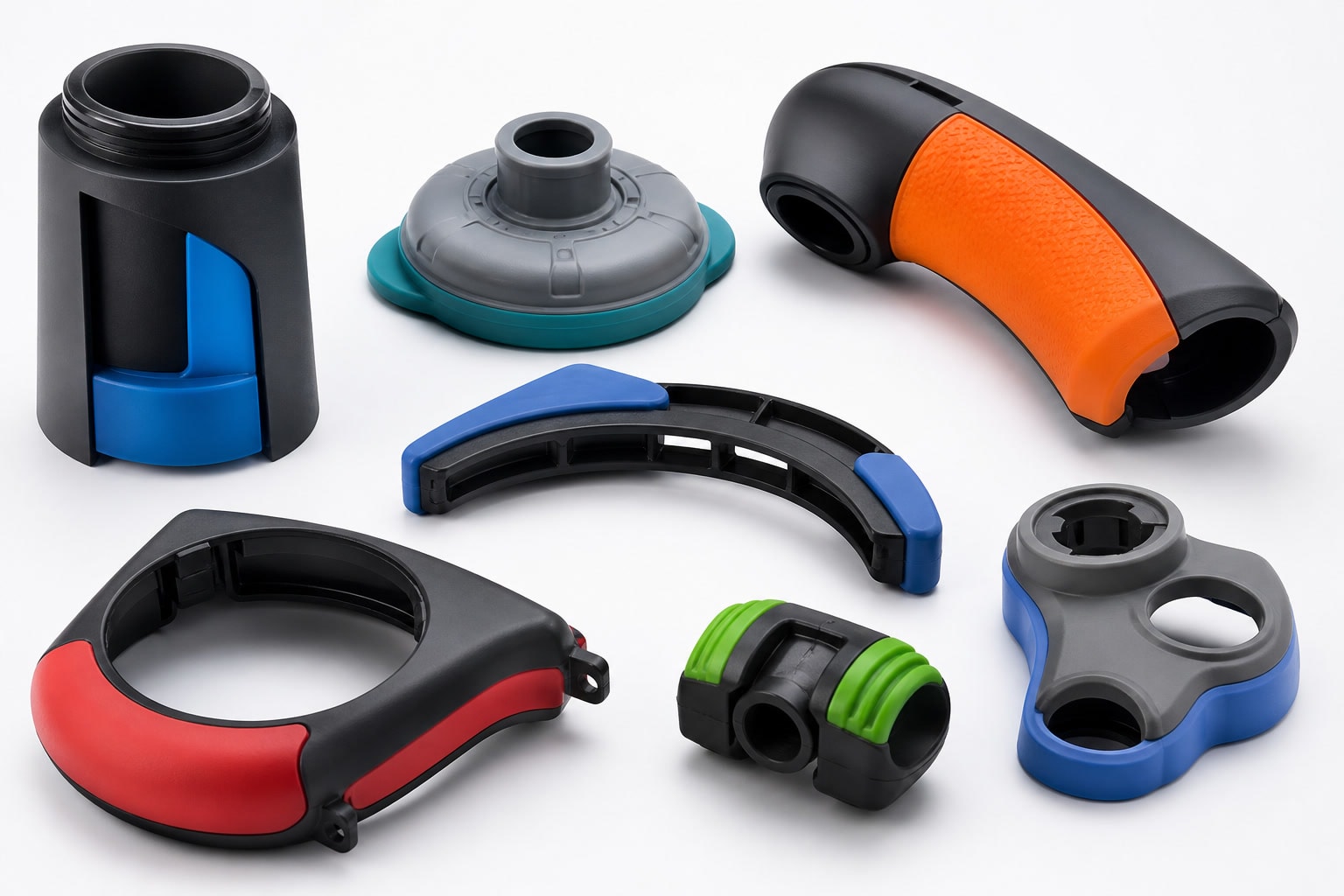
What Multi-Component Molding Delivers
Multi-component molding combines two or more materials in one finished component. In silicone applications, this commonly means molding LSR directly onto a plastic or metal substrate. Customers use this process to obtain:
- ✓ Integrated sealing and gripping features
- ✓ Fewer separate parts and assembly steps
- ✓ Improved water, dust and chemical resistance
- ✓ More consistent placement of silicone features
- ✓ Better ergonomics for handles, buttons and grips
- ✓ Reduced risk of assembly misalignment
- ✓ Repeatable sealing around connectors, housings and inserts
- ✓ A production process suited to prototype validation and high-volume manufacturing
Instead of manufacturing separate components and joining them later, we help evaluate whether overmolding or insert molding can integrate the required functions into one production-ready part.
Our Multi-Component Molding Capability
| Process | LSR overmolding and insert molding |
| Maximum part envelope | 300 × 200 × 100 mm |
| LSR hardness | 10–80 Shore A |
| Typical part tolerance | ±0.05 mm |
| Critical tolerance | Down to ±0.02 mm, application dependent |
| Mold manufacturing tolerance | ±0.01 mm |
| Mold cavities | Single-cavity and multi-cavity |
| Production mold life | Approximately 3–5 million shots, tooling and application dependent |
| Plastic substrates | PC, PA, PBT, PPSU, PPA, PEI and other engineering plastics |
| Metal substrates | Aluminum, stainless steel, brass and copper |
| Bonding strategy | Chemical bonding, mechanical retention or combined strategy |
| Tooling | Prototype tooling and production tooling |
| Surface options | Custom texture, matte or polished surfaces |
| Color | Custom colors and Pantone matching |
| Automation | Automated molding available |
| Post-processing | Post-curing, trimming, printing, laser marking, bonding and assembly |
| Production scale | Prototype to high-volume production |
Actual tolerances, mold life and bonding performance depend on the part geometry, substrate, silicone compound, mold design, production volume and functional requirements. We confirm these conditions during DFM review and sampling.
Materials and Substrates We Mold Together
A successful multi-component molding project depends on both material compatibility and mechanical design. During quotation and DFM review, we consider substrate type, surface condition, temperature exposure, chemical environment, required flexibility and the expected service life of the finished component.
Silicone Materials
| Material | Typical Applications |
|---|---|
| General-purpose LSR | Industrial and electronic components |
| Medical-grade LSR | Medical devices and healthcare products |
| Food-grade LSR | Food, beverage and baby-care products |
| Platinum-cured silicone | Medical and food-contact applications |
| Optical LSR | Optical and lighting components |
| Fluorosilicone | Automotive, fuel and chemical exposure |
| High-temperature silicone | Automotive and industrial environments |
| Low-temperature silicone | Outdoor and automotive applications |
| Electrically conductive silicone | Electronics and EMI-related applications |
| Thermally conductive silicone | Thermal management components |
| Flame-retardant silicone | Electrical and automotive applications |
| Custom compounds | Application-specific performance requirements |
Plastic and Metal Inserts
We support molding LSR over a range of engineered substrates, including:
The substrate may provide structural support, electrical function, dimensional stability or mounting features, while the silicone layer provides sealing, cushioning, insulation, grip or environmental protection.
Applications for Multi-Component Silicone Parts
Our customers typically use multi-component molding when a silicone feature must remain accurately positioned on a rigid component.
Automotive and EV
We manufacture custom components such as:
- Connector seals, wire seals, sensor seals
- Battery seals, grommets, protective boots
- Sealing interfaces for electronic housings
Fluorosilicone, high-temperature silicone, low-temperature silicone and flame-retardant compounds may be considered where fuel, heat, cold or electrical performance is important.
Medical and Healthcare
Potential applications include:
- Device seals, valve components, diaphragms
- Plunger tips, tubing connections
- Sealing elements and soft-touch features on rigid medical components
For medical applications, we review material grade, curing system, cleanliness requirements, dimensional controls and any validation documentation required by the customer.
Electronics and Sensors
Multi-component molding can combine a rigid housing or connector with silicone features for:
- Waterproofing, dust protection, electrical insulation
- Keypads, buttons, housing seals, cable entry protection
- Shock absorption and soft-touch control surfaces
Pumps, Valves and Fluid Control
We support molded silicone components used in:
- Pump diaphragms, check valves, fluid-control membranes
- Valve seals, flexible interfaces, connector sealing assemblies
The design review considers pressure, deflection, compression, chemical exposure, flow path requirements and expected cycle life.
Food, Beverage and Baby Care
For food-contact and baby-care products, we can evaluate food-grade or platinum-cured silicone for applications such as:
- Bottle valves
- Breast pump components
- Food-grade seals
- Tubing connections
- Flexible closures
- Silicone features molded onto rigid components
Material selection and processing requirements should be confirmed against the applicable product and regulatory requirements.
DFM Review Before Tooling
A reliable overmolded part starts with a design that supports both molding and bonding. Before mold manufacturing begins, our engineering team reviews the following:
- •Silicone wall thickness
- •Substrate geometry and dimensional stability
- •Undercuts and mechanical retention features
- •Draft and part release
- •Bonding surfaces
- •Parting lines and flash areas
- •Gate and vent locations
- •Silicone flow paths
- •Insert positioning and loading
- •Substrate tolerances
- •Shrinkage and dimensional compensation
- •Compression and sealing interfaces
- •Required silicone hardness
- •Mold cavity layout
- •Expected production volume
- •Secondary trimming and inspection requirements
This review helps customers identify risks while design changes are still practical. It can reduce late tooling modifications, improve first-sample quality and provide a clearer basis for production approval.
Chemical Bonding
Chemical bonding can provide a continuous connection between LSR and a compatible substrate or treated surface. It may be considered when the part requires:
- A sealed interface with low visible separation
- Protection against fluid ingress
- Stable positioning during service
- A clean integrated appearance
Bonding performance depends on substrate material, surface preparation, primer or adhesion system, molding conditions and environmental exposure.
Mechanical Retention
Mechanical retention uses features such as grooves, holes, undercuts, ribs or through-sections to hold the silicone in place. It may be suitable when:
- The substrate is difficult to bond chemically
- The part experiences mechanical pull or shear
- The design requires a defined retention feature
- Service conditions make mechanical locking preferable
In some applications, a combined chemical and mechanical strategy provides additional security. We define the approach during DFM review and verify it through sampling and functional testing where required.
Tooling for Multi-Component Molding
LSRParts manufactures prototype and production molds for custom silicone components.
| DFM | Available |
| CAD software | SolidWorks and CAD |
| Mold flow review | Supported |
| CNC machining | 3-axis and 5-axis CNC |
| EDM | Sinker EDM and wire EDM |
| Rapid tooling | Aluminum tooling, approximately 100–10,000 cycles |
| Production tooling | Hardened steel tooling |
| Common mold steels | P20, NAK80, H13, S136 and 420 |
| Stainless tooling | 316 and 420 where applicable |
| Aluminum tooling | 6061 and 7075 |
| Tool surface finish | Ra 0.8 μm or better where required |
| Prototype tooling lead-time benchmark | Approximately 10–12 days |
| Production tooling lead-time benchmark | Approximately 3–6 weeks |
| Sampling | T0, T1 and validation sampling |
| Multi-cavity / high-volume tooling | Available |
Lead time depends on part complexity, insert handling, mold construction, cavity count, material requirements and approval cycles. Faster tooling and sampling can help engineering teams test sealing, fit, bonding and assembly earlier, reducing the time spent developing a design that is difficult to manufacture at volume.
From RFQ to Production
Our typical project workflow is:
RFQ and drawing review → DFM review → Material selection → Bonding strategy → Mold design → Tool manufacturing → T0/T1 sampling → Validation → Production approval → Mass production → Inspection → Assembly and packaging
Submit Your RFQ
Provide any available project information, including:
- 2D drawings or 3D CAD files
- Substrate material and supplier information
- Silicone hardness or material specification
- Annual demand or estimated order quantity
- Target application and service environment
- Required tolerances, color and surface requirements
- Bonding or retention expectations
- Testing, inspection requirements and target timing
A complete RFQ allows us to assess tooling, material and production requirements more accurately. If your design is still under development, we can begin with the information available and identify the missing items that affect feasibility and pricing.
Review Design and Materials
We examine the geometry, inserts, tolerances, silicone compound and expected production conditions. This gives you practical feedback on risks that may affect part quality, tooling cost or repeatability.
Build and Sample the Mold
After design approval, we manufacture the selected tooling and produce T0 or T1 samples. Samples can be used to verify fit, appearance, bonding, sealing performance, assembly and key dimensions.
Validate the Production Process
Validation may include dimensional inspection, functional testing, bonding evaluation, leak testing or other application-specific checks. The exact inspection plan is agreed with the customer before production approval.
Move to Repeat Production
Once the part and process are approved, we support ongoing production, secondary operations, inspection, assembly and custom packaging.
Secondary Operations
Molding is only one part of the finished-component process. Depending on the design, we can provide:
- •Post-curing
- •Precision trimming
- •Die cutting
- •Punching
- •X/Y slitting
- •Valve slitting
- •Pad printing
- •Silk screening
- •Laser marking
- •Drilling
- •Bonding
- •Dipping
- •Cutting and coiling
- •Assembly
- •Functional testing
- •Inspection
- •Custom packaging
Using a coordinated production and secondary-operations workflow helps customers reduce supplier handoffs and maintain clearer control over the finished assembly.
Quality and Production Consistency
For production-ready silicone parts, we focus on the characteristics that affect customer assembly and field performance:
- Dimensional consistency and flash control
- Parting-line location and insert position
- Bonding or mechanical retention integrity
- Silicone hardness and color consistency
- Surface condition and sealing performance
- Functional repeatability and cleanliness
- Packaging and traceability requirements defined for the project
Our available inspection and testing activities are selected according to the part drawing, application and customer quality requirements. Critical dimensions and functional features should be identified during the RFQ or DFM stage so that the mold and inspection process can be designed around them.
Why Request a Multi-Component Molding RFQ from LSRParts?
An RFQ review with LSRParts can help you determine:
- Whether LSR overmolding or insert molding fits the part design
- Which silicone hardness and material family may suit the application
- Whether chemical bonding, mechanical retention or both are appropriate
- How substrate tolerances affect the finished component
- Whether a single-cavity or multi-cavity mold is practical
- Which dimensions require tighter control
- What secondary operations are needed after molding
- How prototype tooling can support early validation
- What production tooling and inspection approach may be required
- How the expected annual demand affects tooling and process selection
We focus on custom components for OEMs, product developers and engineering teams that need repeat production. Projects are a good fit when you have a custom drawing or 3D file, a new tooling requirement, an annual demand above approximately 100,000 pieces, or a need for engineering support from prototype through mass production.
Request a Multi-Component Molding Quote
Send your part drawing, CAD file or project requirements to LSRParts for review.
Include the substrate material, silicone requirements, estimated quantity, application conditions and target timing whenever available. We will assess the design for manufacturability, review the likely bonding strategy and provide a quotation path for tooling, sampling and production.
Request an RFQ for your custom multi-component molded silicone part today.
Get a Quote