
Custom Silicone Ear Tips Manufacturer
Custom Silicone Ear Tips Built for Production
LSRParts manufactures custom silicone ear tips for OEMs, consumer electronics brands, hearing and audio equipment companies, and product development teams. Using liquid silicone rubber injection molding, precision tooling, material selection, and secondary operations, we produce production-ready ear tips designed around your device geometry, acoustic requirements, comfort targets, and annual volume.
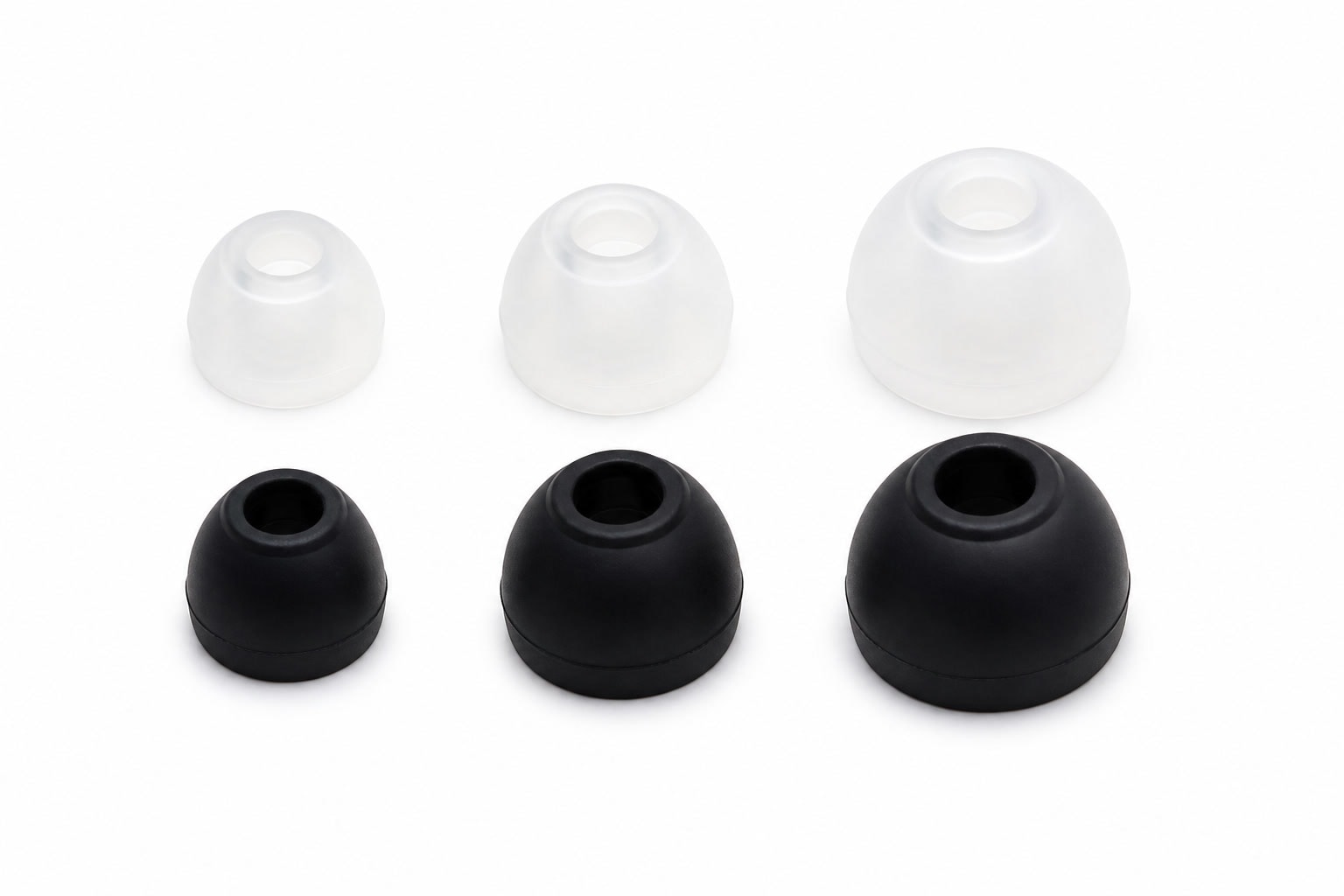
Precision Silicone Ear Tips Built for Production
Silicone ear tips must balance comfort, flexibility, sealing performance, dimensional consistency, and long-term material reliability. Small variations in wall thickness, stem geometry, opening size, or sealing features can affect both user experience and product performance. LSRParts reviews these requirements before tooling begins, helping customers identify potential risks.
Custom Silicone Ear Tip Manufacturing Services
From LSR injection molding to overmolding and compression molding, LSRParts provides a complete range of silicone manufacturing capabilities for custom ear tip programs.
LSR Injection Molding
Liquid silicone rubber injection molding is well suited to precision ear tips with thin walls, soft-touch surfaces, complex profiles, and repeat-production requirements.
| Process | Liquid silicone rubber injection molding |
| Max part envelope | 300 × 200 × 100 mm |
| Silicone hardness | 10–80 Shore A |
| Typical tolerance | ±0.05 mm |
| Critical tolerance | Down to ±0.02 mm |
| Mold cavities | Single and multi-cavity |
| Mold materials | P20, H13, 420 stainless steel |
| Mold life | ~3–5 million shots |
| Surface finish | Matte, polished, textured |
| Secondary ops | Post-curing, trimming, printing, laser marking, bonding, assembly |
Silicone Overmolding & Insert Molding
For ear tips that integrate with rigid carriers, acoustic components, or other substrates, LSR overmolding can combine a soft silicone interface with a plastic or metal component.
Supported Substrates
Potential Applications
- •Detachable ear tip assemblies
- •Rigid internal sleeves and retention features
- •Custom acoustic interfaces
- •Sensor or electronics assemblies
- •Specialized wearable components
Overmolding requirements should be reviewed during DFM because substrate tolerances, surface preparation, mold layout, bonding, and shrinkage can affect the final assembly.
Silicone Compression Molding
Silicone compression molding may be suitable for certain larger, thicker, lower-complexity, or specialized silicone components. It can also be evaluated for programs where the part geometry and production volume make compression tooling appropriate.
Key Parameters
- •Process: Silicone rubber compression molding
- •Typical tolerance: ±0.2 mm
- •Small-part cavity tolerance: ±0.1–0.2 mm
- •Complex-part tolerance: ±0.3–0.5 mm
- •Cavities: Single and multi-cavity
Tooling & Secondary Operations
- •Mold materials: P20, H13, 420 stainless steel
- •Mold life: Up to ~3–5 million shots
- •Secondary ops: Post-curing, trimming, punching, drilling, printing, bonding, assembly
Silicone Materials for Ear Tips
LSRParts helps customers select silicone materials based on softness, flexibility, rebound, environmental exposure, appearance, and application requirements.
| Silicone Material | Potential Application |
|---|---|
| General-purpose LSR | Consumer electronics and general industrial applications |
| Medical-grade LSR | Medical and healthcare devices, subject to project-specific requirements |
| Food-grade LSR | Food, beverage, and baby-care applications |
| Platinum-cured silicone | Applications requiring a clean curing system or specific contact requirements |
| Optical LSR | Transparent or light-related applications |
| Low-temperature silicone | Outdoor or cold-environment applications |
| High-temperature silicone | Automotive or industrial applications |
| Flame-retardant silicone | Electrical and automotive applications |
| Electrically conductive silicone | Electronics and specialized conductive requirements |
| Custom compounds | Application-specific performance requirements |
Design Support for Custom Silicone Ear Tips
A reliable ear tip starts with a manufacturable design. LSRParts provides DFM support before mold construction to help optimize the part for molding and assembly.
Wall Thickness
Consistent wall thickness helps reduce uneven shrinkage, incomplete filling, distortion, and variation in flexibility. Thin or changing sections should be reviewed carefully to ensure stable molding.
Stem & Attachment Geometry
The stem must provide the required fit and retention while allowing reliable demolding. Dimensions should account for silicone elasticity, mating-part tolerances, and repeated installation or removal.
Sealing Features
The outer sealing profile can influence comfort, acoustic isolation, and retention. Ribs, lips, flanges, and flexible sealing surfaces should be evaluated for both functional performance and moldability.
Parting Line & Flash
Parting-line placement is especially important for components that contact the user's skin or interface with an acoustic opening. Mold design should consider flash control, trimming requirements, and parting line location.
Hardness & Rebound
Silicone hardness affects comfort, insertion force, retention, deformation, and sealing behavior. LSRParts supports material evaluation across a typical hardness range of 10–80 Shore A.
Shrinkage & Tolerance
Silicone shrinkage is influenced by material, mold design, processing conditions, geometry, and curing. Critical dimensions should be identified during DFM and verified through sampling and validation.
Color & Surface Finish
Custom ear tips can be produced with custom colors or Pantone matching. Surface options may include smooth, matte, polished, or textured finishes depending on the design and application.
Custom Silicone Ear Tip Applications
LSRParts supports custom silicone ear tip programs across a wide range of industries and applications.
Application-specific requirements may include soft skin contact, repeated assembly, acoustic sealing, water resistance, chemical resistance, cleanability, or compatibility with an internal rigid structure.
Prototype & Production Tooling
| DFM & CAD support | Available, SolidWorks |
| CNC machining | 3-axis and 5-axis |
| EDM | Sinker and wire EDM |
| Rapid tool life | ~100–10,000 cycles |
| Production tooling | Hardened steel |
| Common mold steels | P20, NAK80, H13, S136, 420 |
| Tool surface finish | Ra 0.8 μm or better |
| Prototype lead time | ~10–12 days |
| Production lead time | ~3–6 weeks |
| Multi-cavity tooling | Available |
Silicone Ear Tip Production Workflow
LSRParts supports customers from initial concept through repeat production with a structured, engineering-driven process.
Drawing & 3D Review
Review ear tip geometry, mating interfaces, critical dimensions, and expected volume.
DFM & Engineering
Evaluate wall thickness, draft, undercuts, parting lines, flash, shrinkage, demolding, and bonding.
Material Selection
Recommend silicone material and hardness based on flexibility, comfort, and application.
Mold Design & Build
Develop prototype or production tooling with appropriate cavity layout, gating, venting, and cooling.
Sampling & Validation
T0/T1 sampling, dimensional review, fit testing, validation, and production approval.
Mass Production & Delivery: Manufacture silicone ear tips using single-cavity or multi-cavity tooling according to approved specifications. Complete required trimming, post-curing, marking, assembly, functional testing, inspection, and custom packaging.
Secondary Operations & Quality
Depending on the design and product requirements, LSRParts provides a comprehensive range of secondary operations to complete your custom silicone ear tips.
Secondary operations are selected according to the ear tip design, material, assembly method, appearance requirements, and final application.
Quality & Inspection
Dimensional consistency and functional performance are important for silicone ear tips. LSRParts can establish inspection requirements around:
- •Overall dimensions
- •Stem & attachment dimensions
- •Wall thickness
- •Opening & channel geometry
- •Flash & parting-line control
- •Surface appearance
- •Color consistency
- •Material hardness
- •Assembly fit & retention
- •Functional testing
- •Packaging condition
Typical LSR injection molding tolerances can reach approximately ±0.05 mm, with critical tolerances down to ±0.02 mm depending on geometry, material, tooling, and application.
Why Work with LSRParts?
LSRParts is suited to OEM and Tier supplier programs that require more than a standard silicone product.
- ›Custom parts from customer drawings & 3D data
- ›DFM support before tooling begins
- ›Application-specific material selection
- ›Prototype-to-mass-production support
- ›LSR injection molding & overmolding
- ›Single & multi-cavity tooling
- ›Precision mold manufacturing
- ›Custom color & surface finishes
- ›Secondary operations & assembly
- ›Inspection & functional testing
- ›Production above 100,000 pcs/year
- ›Engineering support for repeat production
Production Capabilities at a Glance
Request a Quote for Custom Silicone Ear Tips
To evaluate a custom silicone ear tip project, LSRParts can review your design, recommend a suitable silicone molding process, identify manufacturing risks, and develop a path from prototype tooling to stable production.
Provide the Following Information:
- •2D drawing or 3D CAD file
- •Target silicone hardness
- •Material or compliance requirements
- •Estimated annual demand
- •Prototype quantity
- •Production quantity
- •Required color and surface finish
- •Mating component or assembly info
- •Functional & dimensional requirements
- •Packaging requirements
- •Target production schedule
Frequently Asked Questions
Can you manufacture silicone ear tips from a customer drawing?
Yes. LSRParts focuses on custom silicone components produced around customer drawings, 3D files, application requirements, and production targets.
What silicone hardness can be used for custom ear tips?
LSRParts supports silicone hardness from approximately 10 to 80 Shore A for LSR injection molding. The appropriate hardness depends on comfort, flexibility, retention, sealing, and the complete product design.
Can you make colored silicone ear tips?
Yes. Custom colors and Pantone matching are available, subject to the selected material and application requirements.
Do you support multi-cavity molds?
Yes. Single-cavity and multi-cavity tooling are available. Cavity count should be selected according to production volume, part complexity, tooling cost, and consistency requirements.
Can silicone ear tips be overmolded onto another component?
Yes. LSR overmolding and insert molding are supported for compatible plastic and metal substrates. The bonding strategy should be evaluated during DFM.
What is the typical tolerance for silicone ear tips?
A typical LSR molding tolerance is approximately ±0.05 mm, while critical features may reach approximately ±0.02 mm depending on part geometry, material, mold design, and application. Final tolerances require engineering review.
Can you provide prototypes before mass production?
Yes. LSRParts supports prototype tooling, T0/T1 sampling, validation, production approval, and transition to mass production.
Do you provide assembly and packaging?
Yes. Available services include bonding, assembly, functional testing, inspection, and custom packaging, depending on the project requirements.