
Thermal Gap Pads Manufacturer for Custom RFQ Projects
We manufacture custom silicone-based thermal interface components for OEMs, product developers, and engineering teams that need reliable heat transfer, stable compression, and repeatable production.
If you are sourcing a pad for a new device, we help you move from drawing review to tooling, sampling, validation, and mass production with a process built around your thermal target, stack-up, and assembly constraints.
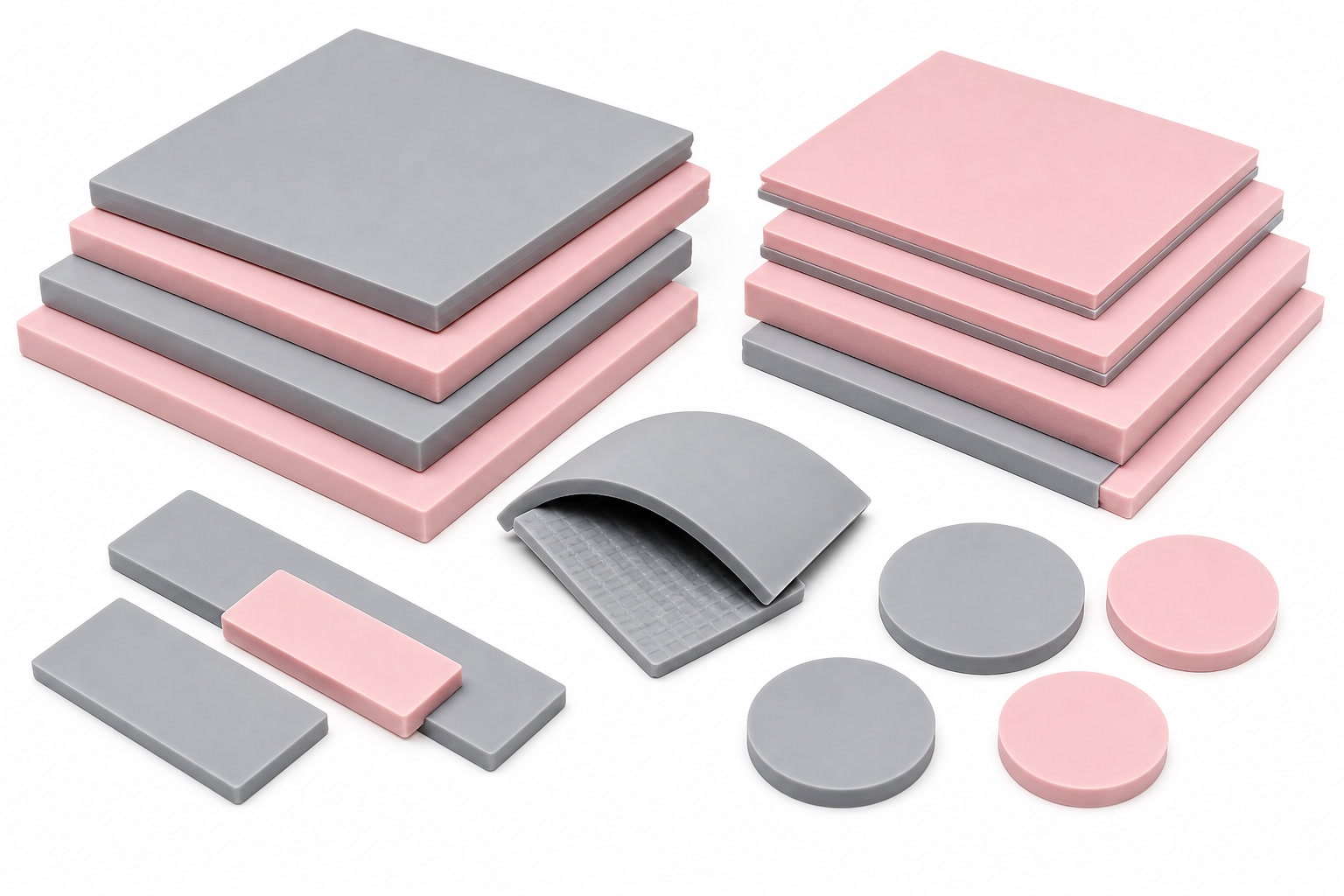
Why customers send us an RFQ
Thermal gap pad projects usually fail when the part is treated as a generic rubber sheet. We focus on what your product needs in production.
Consistent thermal contact
Heat moves reliably from the component to the heat sink or housing.
Controlled thickness and compression
The pad fits the real assembly gap, not just the drawing.
Stable geometry after repeated cycles
The interface stays reliable during long-term use.
Custom material selection
Softness, insulation, flame resistance, or conductive fillers matched to your application.
Production-ready manufacturing
The approved sample scales without redesigning the part later.
What we make
We support custom Thermal Gap Pads for applications that need shaped silicone components, thermal interface features, or multi-material structures. Depending on your design, we manufacture pads through silicone molding, overmolding, or secondary processing.
- Custom cut pads and formed silicone thermal components
- Molded pads with defined thickness and edge geometry
- Overmolded structures for sealing plus thermal management
- Pads with slots, bosses, cutouts, or installation features
- Parts that combine thermal performance with electrical insulation
How our process helps your project
A good thermal pad is not only about material choice. It is about the full manufacturing path.
We review:
- • Gap height and compression range
- • Contact area and heat path
- • Surface flatness and mating tolerance
- • Required hardness and recovery
- • Assembly method and retention needs
- • Expected production volume
- • Validation and inspection requirements
This helps reduce risks before tooling starts, which means you get a clearer path from prototype to production approval.
Manufacturing capabilities
Precision silicone molding with tight tolerances for thermal interface applications.
| Capability | Specification |
|---|---|
| Process | Liquid silicone rubber injection molding / silicone compression molding / overmolding |
| Maximum part envelope | 300 × 200 × 100 mm for LSR molding |
| Compression molding size | Up to 2500 × 2000 × 1000 mm |
| Silicone hardness | 10–80 Shore A |
| Typical part tolerance | ±0.05 mm for LSR molding, application dependent |
| Critical tolerance | Down to ±0.02 mm, application dependent |
| Mold manufacturing tolerance | ±0.01 mm |
| Part-to-part repeatability | Approx. ±0.1 mm, geometry dependent |
| Mold cavities | Single-cavity / multi-cavity |
| Mold materials | P20 / H13 / 420 stainless steel |
| Tooling type | Prototype tooling / production tooling |
| Production scale | Prototype to high-volume mass production |
| Color | Custom / Pantone matching |
| Surface | Custom texture / matte / polished |
| Secondary operations | Post-curing, trimming, printing, laser marking, bonding, assembly, inspection |
Material options for thermal gap pad applications
We match the compound to the thermal, mechanical, and environmental requirement of the part.
| Material | Typical use |
|---|---|
| General purpose LSR | Industrial and electronics components |
| Thermally conductive silicone | Thermal management parts and heat transfer interfaces |
| Electrically conductive silicone | EMI-related electronic assemblies |
| High-temperature silicone | Automotive and industrial environments |
| Flame-retardant silicone | Electrical and automotive applications |
| Medical grade LSR | Medical device programs that require clean processing |
| Custom compounds | Application-specific performance targets |
If your project needs a specific balance of softness, compression set resistance, dielectric strength, or heat transfer behavior, we can support compound selection during DFM review.
What you get from our DFM review
Before we begin tooling, we evaluate the design against manufacturability and performance goals.
- Fewer redesign loops after sampling
- Better control over fit and compression in the final assembly
- Lower risk of flash, warpage, or inconsistent thickness
- A more realistic path to repeat production
- Clearer alignment between your drawing and the actual application
For Thermal Gap Pads, this is especially important when the pad must sit between a heat source and a housing with limited space.
Secondary operations that support production
We can complete the operations needed to deliver a part that is ready for assembly:
Typical applications
Our custom Thermal Gap Pads are used in programs where thermal stability and repeatable assembly matter, including:
Ideal customers
We are a fit for teams that need repeat production, not commodity stock parts.
Our typical customers have:
- • Custom drawings or 3D files
- • New tooling requirements
- • Annual demand above 100,000 pcs
- • Precision or functional requirements
- • Prototype-to-mass-production programs
- • Need for DFM and engineering support
What to include in your RFQ
To speed up review, please send:
Request a quote for custom Thermal Gap Pads
If you need custom Thermal Gap Pads for an electronics, automotive, medical, or industrial program, send us your drawing and application targets. We will review the geometry, material options, and production method, then give you a practical path from RFQ to sample approval.
For projects that need consistent fit, stable thermal contact, and repeat production, we are ready to support your next build.
Contact us directly:
Send us your project details
Include drawings and application targets for the fastest response.
Request a Quote